Treatments
PCL Surgery
Specialist care for posterior cruciate ligament injuries, from guided rehabilitation to arthroscopic reconstruction.
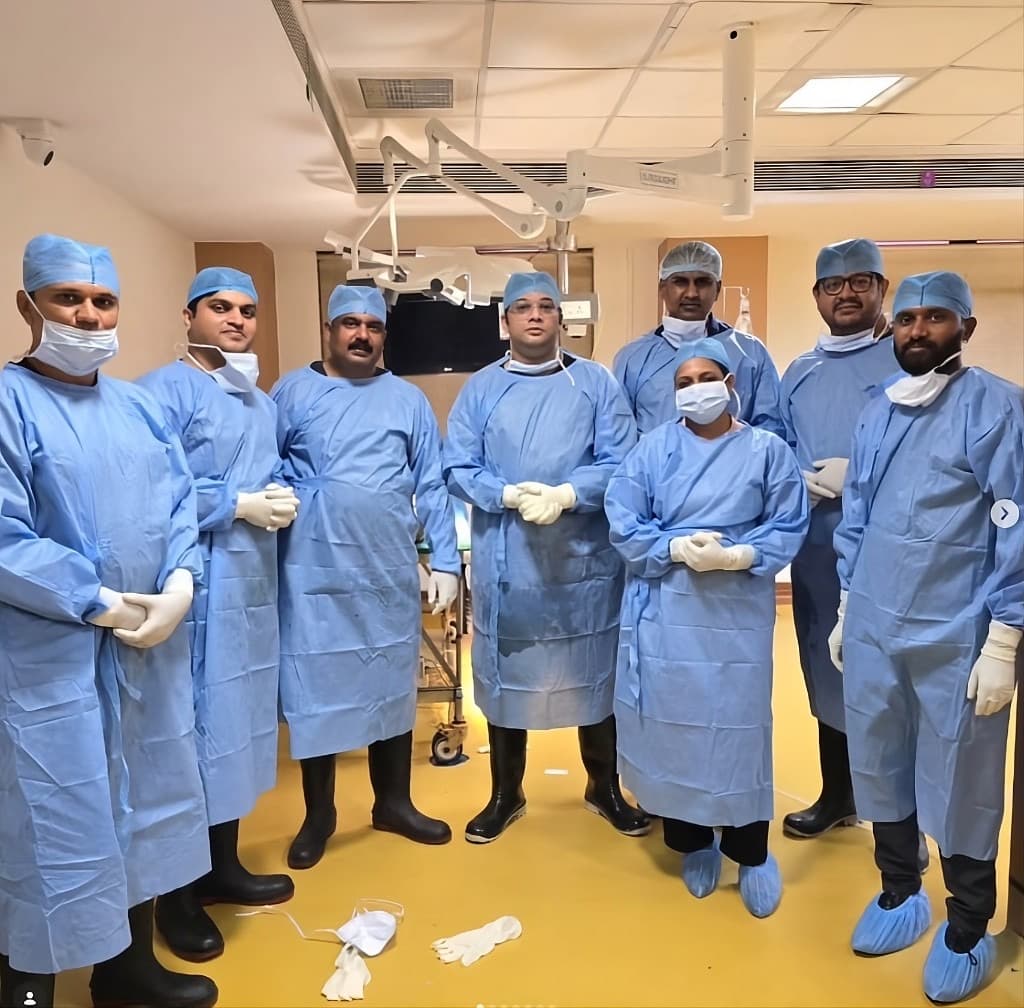
Understanding the procedure
The posterior cruciate ligament (PCL) is the strongest ligament in the knee, preventing the shin bone from sliding backwards. It is usually injured by a direct blow to the front of a bent knee, classically against a dashboard in road accidents, or during falls in sport. PCL injuries behave differently from ACL tears: many partial tears heal well with bracing and structured rehabilitation, so accurate grading of the injury is the key first step.
Dr. Manish Saini assesses PCL injuries in Surat with clinical testing and MRI, and reserves surgery for the knees that genuinely need it: high-grade tears, injuries combined with other ligaments, and knees that stay symptomatic after proper rehabilitation. When reconstruction is required, it is performed arthroscopically with a tendon graft, followed by a carefully staged recovery that protects the healing ligament.
When to take knee instability seriously
If several of these sound familiar, it is worth a proper assessment. Naming the problem early keeps more options open.
Pain and swelling at the back of the knee after a direct impact
A vague, unstable feeling rather than dramatic giving way
Difficulty decelerating, descending stairs or walking downhill
Pain behind the kneecap that appears weeks after the injury
Discomfort when kneeling or squatting
A knee that tires and aches with activity
Stiffness after sitting with the knee bent
Is it the right time?
Surgery is offered only when it is clearly the better path. These are the signs that usually tip the balance.
MRI confirms a high-grade (grade III) PCL tear with marked backward laxity of the shin.
The PCL injury is combined with damage to other ligaments, a pattern that rarely does well without surgery.
Instability or pain persists despite 3 months of dedicated bracing and rehabilitation.
A piece of bone has pulled off with the ligament (avulsion fracture) and needs fixation.
Your sport or occupation demands confident deceleration and downhill control.
Your treatment options
Non-surgical care always comes first. Surgery enters the conversation only when simpler measures no longer control your symptoms.
PCL bracing and rehabilitation
Where treatment begins
Most isolated grade I-II tears heal with a dedicated PCL brace that supports the shin, followed by a quadriceps-focused strengthening programme. This is the default first path, not a compromise.
Progressive strength training
The quadriceps acts as a natural PCL, actively holding the shin forward. A supervised programme built around it restores stability for the majority of partial injuries.
Fixation of bony avulsions
When the ligament pulls off with a fragment of bone, fixing that fragment back early gives the best chance of a naturally healed ligament.
Arthroscopic PCL reconstruction
For high-grade or combined injuries, the ligament is reconstructed with a tendon graft through keyhole incisions, often together with other injured ligaments in a single operation.
What this treatment changes
The outcomes that matter to patients, stated plainly.
Surgery only when needed
Accurate grading means the majority of PCL injuries are cured in a brace, and the operated few are the right few.
Restored stability
Reconstruction re-centres the joint, restoring confident deceleration, stairs and downhill walking.
Protection of the joint surface
Correcting backward laxity reduces abnormal pressure on the kneecap and inner knee, guarding against early wear.
Keyhole technique
Arthroscopic reconstruction uses small incisions and allows combined ligament injuries to be addressed in one sitting.
A staged, protected recovery
A clear bracing and physiotherapy protocol protects the graft at every phase, so you always know what is safe.
Recovery
Your road back, phase by phase
Every recovery is individual. These are the typical milestones patients can expect, reviewed together at each follow-up.
Week 0-6
Protection
A PCL support brace holds the shin in position while the graft or healing ligament is protected. Quadriceps activation starts immediately.
Week 6-12
Guarded motion
Knee bend is progressively restored and weight-bearing builds to full. The brace is weaned as control returns.
Month 3-6
Strength
Gym-based strengthening centred on the quadriceps rebuilds the muscle support the PCL relies on.
Month 6-9
Dynamic loading
Jogging progresses to running, jumping and change-of-direction work as strength tests are passed.
Month 9-12
Return to sport
Full sport resumes once strength and stability criteria are met. PCL rehabilitation is deliberately slower than ACL, and patience protects the result.
Questions patients ask
Honest answers to the questions raised most often in the clinic.
Related treatments
Discuss PCL surgery with Dr. Saini.
A careful examination, an honest opinion and a plan you understand. OPD hours: Mon to Sat, 10:00 AM to 1:00 PM and 5:00 PM to 8:00 PM.